The Scent of Ink Collected on the Road: Chunibak's 25-Year Journey Through Landscape, Traversing Tradition and Modernity
September 17, 2026
[기자칼럼] 길 위에서 채집한 묵향, 전통과 현대를 가로지르는 추니박의 25년 산수 기행
황경선 기자 (더브리프뉴스)
한국화의 위기라는 진단이 오랜 시간 미술계 안팎에서 자조처럼 떠돌 때 먹과 한지를 들고 거침없이 야생의 들판과 이국의 대지로 걸어 나간 화가가 있다. 바로 '추니박'이라는 유연하고도 직관적인 이름으로 우리에게 익숙한 박병춘 작가다.
**2026년 9월 세종뮤지엄갤러리에서 개최된 《추니박 산수풍경의 기록》**은 작가가 25년간 묵묵히 그러나 극적으로 일궈낸 '산수풍경 회화'의 거대한 궤적을 한눈에 굽어볼 수 있는 뜻깊은 회고적 자리다. 이번 전시는 단지 한 작가의 지나온 세월을 복기하는 데 그치지 않고 지필묵(紙筆墨)이라는 전통 매체가 현대 미술의 공간 속에서 어떻게 생생하게 스며들고 변용될 수 있는지를 증명하는 명료한 현장이다.
전시장에 들어서면 가장 먼저 시선을 사로잡는 것은 대형 한지 위에 스펙터클하게 펼쳐진 대자연의 호흡이다. 〈세상의 중심 울루루를 가다〉(2015)부터 최근작 〈길이 있는 풍경〉(2026)에 이르기까지 그의 화폭은 거대하지만 결코 압도적인 권위로 관객을 누르지 않는다. 오히려 그 안에는 길 위에서 바람을 맞고 햇살을 견디며 온몸으로 자연을 채집해 온 한 예술가의 정직한 노동과 인간적인 온기가 흐른다.
추니박의 25년 여정은 '경계의 파괴와 확장'으로 요약된다. 2000년대 초반, 그는 관훈갤러리 《동풍전》에서 칠판에 분필로 그림을 그리고 지우는 〈무소유-칠판산수〉 퍼포먼스를 선보였고 공중에 흩날리는 얇은 한지 작업으로 관객들에게 기억의 가변성을 던졌다.
이뿐인가. 인공적이고 일상적인 재료인 '라면'의 구불구불한 형태에 착안해 지형의 필선과 결합한 '라면준'을 창안하고 라면 수천 개를 엮어 만든 '라면산수'나 버려진 검은 비닐봉지를 활용한 설치 작업, 성곡미술관 전시장 바닥 전체에 물을 채우고 단풍나무를 거꾸로 매단 파격적인 연출은 한국화가 가질 수 있는 시공간적 한계를 경쾌하게 뒤흔들었다. 이는 먹과 붓이라는 재료적 고집에 갇히지 않고, '풍경을 경험하는 물리적 공간' 그 자체를 회화의 영역으로 끌어들인 독창적 시도였다.
그러나 그의 현대적 파격이 가벼운 겉멋에 그치지 않는 이유는 그 밑바탕을 지탱하는 엄청난 스케치와 사생의 힘에 있다. 2002년부터 이어진 200여권에 달하는 방대한 화첩 사생은 추니박 회화의 견고한 뿌리다. 작가는 카메라의 렌즈가 왜곡하는 기계적 풍경을 거부하고 오로지 자신의 눈과 손, 그리고 현장의 미세한 오감에 의존해 풍경을 채집했다. 사진을 보고 베껴 그리지 않는 이 정직한 엄격함이 유타의 붉은 암벽과 오레곤의 절벽, 세도나와 그랜드캐넌이라는 낯선 이국의 풍경마저도 동양의 서정적 필선과 감각적인 채색으로 완벽히 번안해 낼 수 있었던 동력이었다.
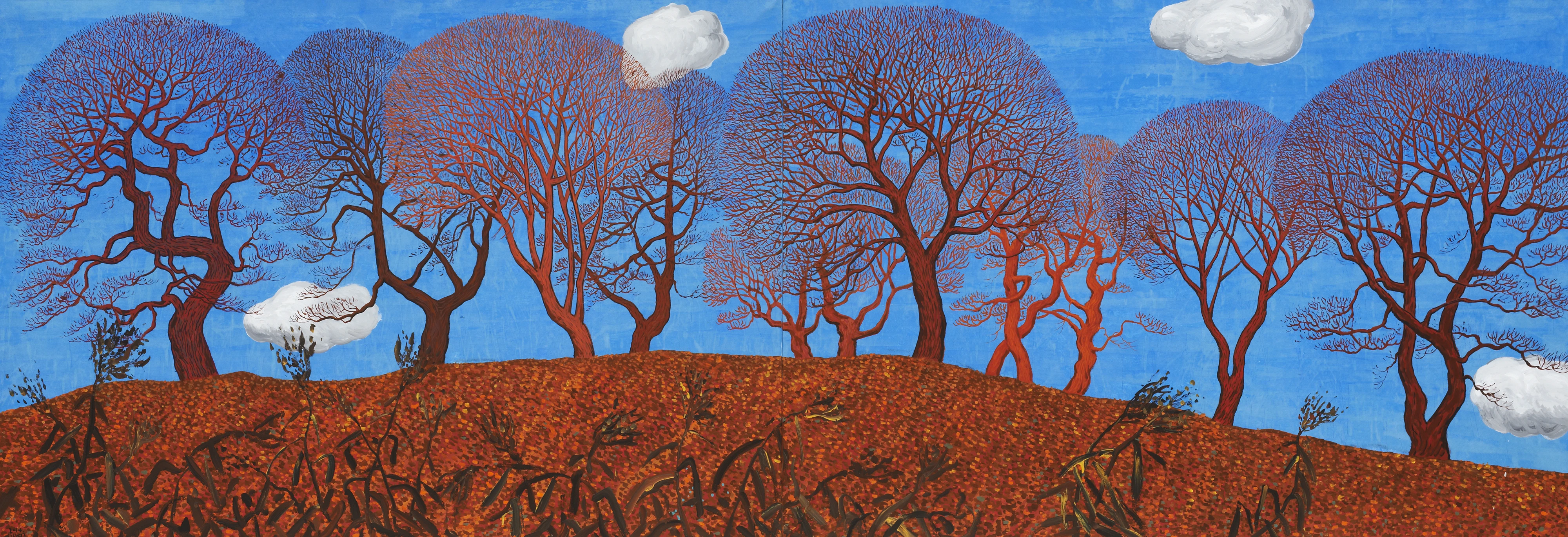
이번 전시에서 특히 주목하게 되는 지점은 2010년대 후반부터 본격화된 '숲' 연작의 진화 과정이다. 작가가 숲속에서 3년 이상 머물며 완성한 150여 점의 〈치유의 숲〉이 현장의 생명력과 자연의 순환을 감각적으로 담아낸 '체험의 기록'이었다면, 최근의 〈사유의 숲〉은 한 차원 높은 내면적 승화를 보여준다.
작가는 “이전의 방식이 먹의 표현 자체에 집중했다면, 지금은 수묵의 깊이와 빛에 대한 탐구다. 잎과 가지 사이로 스며드는 빛을 통해 보이지 않는 인간의 간절한 슬픔과 그리움 같은 정서를 수묵풍경으로 구현해 내는 것에 몰두하고 있다”라며 자신의 변화된 회화적 고백을 나직이 전한다.
색채를 절제하고 다시 먹의 근본적인 깊이로 돌아간 최근작들 속에서 나무와 숲은 실제 장소를 넘어 작가가 동경하고 그리워하는 심상(心象)의 공간으로 재탄생한다. 나뭇가지 사이로 스며 나오는 희미한 빛의 표현은 수묵이 가진 단색의 한계를 뛰어넘어 인간 내면에 자리한 슬픔과 고독, 그리고 위로의 정서를 처연하도록 아름답게 비추고 있다.
'추니박'은 스스로에게 쉼 없이 질의를 던지는 길 위의 화가다. 전통적 수묵의 묵직함에 갇히지도, 그렇다고 서구적 채색 회화의 표피성에 휩쓸리지도 않으며, 그는 동양의 기운생동(氣韻生動)한 필선과 서양의 평면적 색채 감각을 완벽하게 융합해 냈다. 거대한 한지 위를 가로지르는 그의 먹선과 아크릴 물감의 레이어는 자연을 정복의 대상이 아닌 '조건 없이 인간을 품어주는 안식처'로 바라보는 작가의 온화한 세계관을 고스란히 반영한다.
세종뮤지엄갤러리 벽면에 걸린 25년의 스케치와 대작들은 묻고 있다. "당신이 바라보는 풍경은 진짜 당신의 것인가, 아니면 스쳐 지나간 환상인가?" 추니박이 200여 권의 스케치북과 수많은 화폭 위에 새겨 넣은 산수의 궤적은 현대화라는 거센 파도 속에서도 고유한 자기 화법을 찾아 끊임없이 걷고 또 걸었던 한 거장의 아름다운 정진(精進)의 기록이다. 대자연의 깊은 숨결과 수묵의 새로운 가능성을 체감하고 싶은 이들에게 이번 전시는 놓칠 수 없는 진귀한 성찰의 기회가 될 것이다.
[에필로그] 추니박은 작품에 수많은 해학을 숨겨 놓는 것으로도 유명하다. 이번에 전시된 〈흐르는 풍경 (2007)〉에는 태안 기름유출, 원더걸스의 텔미, 김연아의 피겨스케이팅 등 시대적 순간을 상징하는 여러 숨은 그림들이 재치 있게 포함되어 있습니다.
English
[Reporter's Column] The Scent of Ink Collected on the Road: Chunibak's 25-Year Landscape Journey Traversing Tradition and Modernity
By Hwang Kyung-sun, Reporter (The Brief News)
At a time when the diagnosis of a crisis in Korean painting has long circulated as a self-deprecating lament within and outside the art world, there is an artist who, with ink and hanji (Korean paper) in hand, fearlessly walked out into wild fields and foreign lands. This is artist Park Byung-chun, familiar to us by the flexible and intuitive name 'Chunibak'.
«Chunibak's Record of Landscape Scenery» held at Sejong Museum Gallery in September 2026, is a meaningful retrospective opportunity to survey at a glance the vast trajectory of 'landscape painting' that the artist has quietly yet dramatically cultivated over 25 years. This exhibition is not merely a review of an artist's past years, but a clear demonstration of how traditional media such as paper, brush, and ink (jipilmuk) can vividly permeate and transform within the space of contemporary art.
Upon entering the exhibition hall, the first thing that captivates the eye is the spectacular breath of nature unfolding on large hanji. From 〈Going to Uluru, the Center of the World〉 (2015) to his recent work 〈Landscape with a Path〉 (2026), his canvases are vast but never overwhelm the viewer with imposing authority. Rather, they exude the honest labor and human warmth of an artist who has collected nature with his entire body, enduring wind and sunlight on the road.
Chunibak's 25-year journey can be summarized as 'the destruction and expansion of boundaries'. In the early 2000s, at the Gwanhoon Gallery's «Dongpungjeon» exhibition, he presented the 〈Non-Possession - Chalk Landscape〉 performance, drawing and erasing on a blackboard with chalk, and challenged viewers with the variability of memory through delicate hanji works scattered in the air.
And that's not all. He invented 'Ramenjun', inspired by the winding shapes of 'ramen', an artificial and everyday material, combining it with the brushstrokes of topography. His 'Ramen Landscape' made by weaving thousands of ramen noodles, installation works using discarded black plastic bags, and the unconventional staging of filling the entire floor of the Sungkok Art Museum with water and hanging maple trees upside down, playfully shook the spatiotemporal limitations that Korean painting could possess. This was an original attempt that was not confined to the material stubbornness of ink and brush, but rather drew the 'physical space of experiencing landscape' itself into the realm of painting.
However, the reason his modern unconventionality does not remain a superficial affectation lies in the immense power of sketching and plein air drawing that underpins it. The extensive sketchbooks, numbering over 200 volumes, from 2002 onwards, are the solid roots of Chunibak's painting. The artist rejected the mechanical landscapes distorted by camera lenses, relying solely on his eyes, hands, and the subtle five senses of the現場 to collect landscapes. This honest rigor of not copying from photographs was the driving force that allowed him to perfectly adapt even the unfamiliar foreign landscapes of Utah's red cliffs, Oregon's bluffs, Sedona, and the Grand Canyon with the lyrical brushstrokes and sensuous coloring of the East.
A particularly noteworthy aspect of this exhibition is the evolution of the 'Forest' series, which began in earnest in the late 2010s. If the 150 or so works of 〈Forest of Healing〉, completed by the artist after staying in the forest for over three years, were a 'record of experience' that sensuously captured the vitality of the現場 and the cycle of nature, the recent 〈Forest of Contemplation〉 shows a higher level of inner sublimation.
The artist quietly conveys his changed artistic confession, stating, “If the previous method focused on the expression of ink itself, now it is an exploration of the depth and light of ink wash. I am engrossed in realizing human emotions such as earnest sorrow and longing, which are invisible, through ink wash landscapes, by means of the light seeping through leaves and branches.”
In his recent works, where color is restrained and he returns to the fundamental depth of ink, trees and forests are reborn beyond actual places into spaces of mental imagery that the artist yearns for and misses. The expression of faint light seeping through the branches transcends the monochromatic limitations of ink wash, beautifully illuminating the sorrow, solitude, and comfort within the human psyche with a poignant beauty.
'Chunibak' is an artist on the road who constantly questions himself. Neither confined by the gravitas of traditional ink wash nor swayed by the superficiality of Western colored painting, he has perfectly fused the vibrant brushstrokes (giunsaengdong) of the East with the planar color sensibility of the West. His ink lines and layers of acrylic paint traversing vast hanji fully reflect the artist's gentle worldview, which views nature not as an object of conquest but as 'a sanctuary that unconditionally embraces humanity'.
The 25 years of sketches and masterpieces hanging on the walls of the Sejong Museum Gallery ask, “Is the landscape you see truly yours, or is it a fleeting illusion?” The trajectory of landscapes Chunibak has etched into over 200 sketchbooks and countless canvases is a record of a master's beautiful diligence (jeongjin), who continuously walked and walked, finding his unique artistic style amidst the fierce waves of modernization. For those who wish to experience the deep breath of nature and the new possibilities of ink wash, this exhibition will be an invaluable opportunity for reflection not to be missed.
[Epilogue] Chunibak is also known for hiding numerous humorous elements in his works. In 〈Flowing Landscape (2007)〉, exhibited this time, various hidden images symbolizing historical moments such as the Taean oil spill, the Wonder Girls' 'Tell Me', and Kim Yuna's figure skating are cleverly included.